A Slow Read of a Busy News Feed
A slow read of a busy news feed helps you spot attention cues, separate observation from inference, and decide what deserves another moment.
The common mistake in a busy news feed is letting its strongest attention cue choose what you believe deserves attention. A slow read of a busy news feed helps you notice how layout, repetition, and timing shape your next glance before you decide what to open or pass by.
Use this exercise on one feed item when you have a moment to pause. The focus is not to verify every claim in it, but to see how the feed organizes your attention: what it places in front of you, what it hides below the fold, and what it invites you to do next.
Choose a feed moment
Select one post, headline, clip, or recommendation card as it appeared in the feed. Keep the surrounding interface in view: note whether the item was marked sponsored, appeared after repeated similar posts, or arrived with a notification. Those details can shape attention even when they say nothing about whether the item is accurate.
Write down the feed context before opening links. Record the item’s position in the visible sequence, any label or alert attached to it, and whether you had already seen similar material. This is a brief observation, not a judgment about why the platform displayed the item.
It is not worth trying to infer the platform’s private ranking logic from a single screen. Stick to what you can see and what it did to your attention.
Separate cue and response
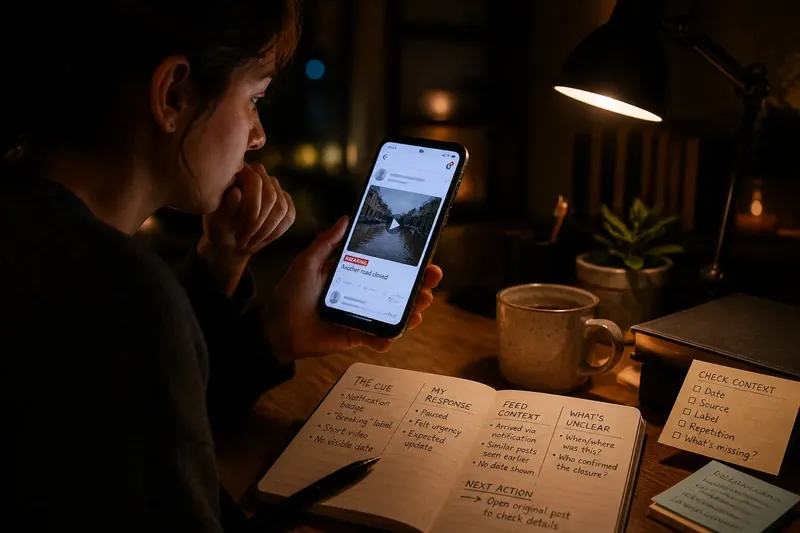
Name the feature that first caught your eye: perhaps a bright warning banner, an autoplaying clip, a familiar account, a red notification badge, or a caption that appeared before the image loaded. Then describe your immediate response in plain terms, such as “I paused,” “I felt urgency,” or “I expected another update.”
Keep the visible cue separate from your interpretation of it. “The post had a red alert label” is an observation; “the platform knows this is important” is an inference. Noticing the distinction helps prevent interface design from borrowing the authority of the information it surrounds.
Say you encounter an invented feed card with a bold “Breaking” label, a short clip, and no visible date. You note the label and that you stopped scrolling, then record that the missing date leaves the clip’s timing unclear. The observable result is a pause in your scrolling, not proof that the event is new.
Map the attention path
Follow the sequence your eyes and actions took. Did you read the caption before seeing the full clip? Did a notification bring you back to an older post? Did the next item repeat the same topic, making it seem more prominent? A feed can guide attention through ordering and repetition without making a direct argument.
Use this compact list to decide what the feed context supports:
- If an item has a sponsored label, record that it is presented as advertising; if the label is absent or unclear, do not assume the item is unpaid—check the account or disclosure if that distinction matters.
- If a notification links to an older post, note the post’s visible date; if no date is available, treat its timing as unresolved and avoid calling it new.
- If similar posts appear in sequence, record the repetition; if they point to the same original material, treat them as repeated exposure rather than independent confirmation.
- If autoplay begins before you choose to play, note that the clip started automatically; if you need to assess its content, pause it and choose whether to continue deliberately.
- If a headline or caption appears without its linked page, record the missing context; if the wording could change your interpretation, open the source before relying on the snippet.
- If a post is prominent because it sits at the top of the screen, record its position; if you need to compare its importance with other items, inspect the surrounding feed rather than using placement as evidence.
Each observation answers a narrow question about how you encountered the item. None establishes that the item is true, false, important, or widely shared.
What does the feed change?
Does repetition mean confirmation?
No. Several posts may repeat one source or one underlying assertion, so repetition in a feed shows exposure, not independent support. Trace whether the items lead to distinct material before treating them as separate accounts.
Can placement show importance?
Placement shows where the item appeared in your feed, not why it was placed there or how important the underlying event is. Treat position as context for your attention, then look for a separate basis for any judgment about importance.
What if a label is unclear?
Record the exact label or say that its meaning is unclear rather than guessing. If the distinction affects your next action, open the account or disclosure information that the interface provides.
When should I stop?
Stop once you can describe the visible cue, your response, and any feed context that affected what you saw. If the item still raises a substantive question, handle that separately instead of expecting the interface to answer it.
Work through one item
Imagine an invented neighborhood feed card showing a short video of water flowing across a street. Its caption says, “Another road closed,” and a notification badge draws your eye. You first record the observable details: the clip shows water on one street, the caption claims another road is closed, the card displays no visible date, and the badge prompted you to pause.
Next, note the limits of that encounter. The clip’s location and date are not established by what you can see, and the caption does not identify who confirmed a closure. You then choose to open the linked post rather than share the card. If that post names the street and gives a current notice, you can assess those details; if it supplies neither, the closure remains unconfirmed by this item. In either case, the feed observation has done its job: it has separated the reason you stopped from the information you still need.
Choose the next action
Write a short note that keeps the parts distinct: “The cue was ___. I responded by ___. The feed context showed ___. The item itself still leaves ___ unclear.” Then choose a next action that fits what remains unresolved:
- If the issue is only that the card interrupted your scrolling, move on without treating the interruption as evidence.
- If the item’s date or source matters, open the linked original material or set the item aside until you can locate it.
- If similar posts have repeated the same claim, look for a genuinely separate source rather than counting appearances.
- If you share the item, describe what is visible and preserve any uncertainty about its context.
A slow read of a busy news feed is useful when it gives you control over the next glance: you can choose to open, pause, verify elsewhere, or move on. The small but important distinction is between what captured your attention and what the item gives you reason to conclude.