How Image Captions Shape What a Picture Means
Learn how image captions frame a picture, trace its source, and separate visible details from claims the image alone cannot establish.
The common mistake is to treat an image caption as a neutral label, then assume the picture speaks for itself. That shortcut can turn an uncertain scene into an apparent fact: a photograph of a crowded street might be presented as a protest, celebration, or evacuation. To read it carefully, separate what you can see from what the caption claims.
Visible details and claims
A caption is text attached to an image that names, describes, identifies, or interprets what viewers see. A photograph can show people gathered around a doorway, but it cannot by itself establish when the scene occurred, what happened before the shutter clicked, or why the people are there.
A caption may supply some of that context. It may also make a claim the image cannot verify. Readers often combine picture and words into one impression, so details in the frame can seem to confirm a caption even when they do not. The image may support the caption, contradict it, or leave the question unresolved.
Captions across formats
Captions appear in many settings: beneath photographs in books and newspapers, beside images in reports, as on-screen text in broadcasts, and alongside posts or gallery images online. Their form and placement vary, but a useful distinction remains: some words identify visible content, while others connect it to a time, place, event, or interpretation.
A caption can travel separately from the image’s original publication. It may be shortened, translated, or replaced when a photograph is reposted. The picture may remain recognizable while the new words suggest a different meaning. Without reliable information about a caption’s origin, avoid treating it as a settled account of the scene.
This is not a simple story of captions changing from plain labels into manipulation. A single line can identify a person accurately while making an unsupported suggestion about their actions. The useful question is what the caption claims, and what evidence supports that claim.
Three layers of context
These three layers help distinguish what a caption contributes from what the image itself makes visible.
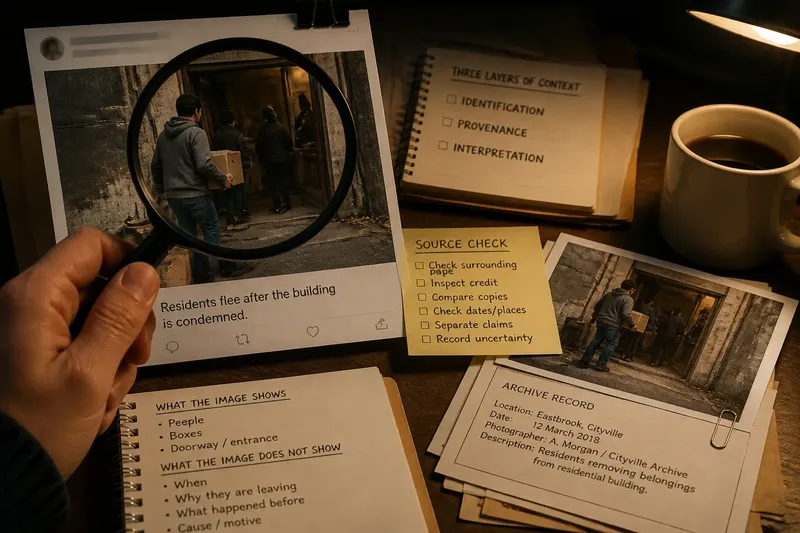
- Identification: Check whether the caption names a person, place, object, or activity. If the name or description has no supporting source, treat it as unverified; if a reliable source supports it, keep the identification separate from claims about motive or responsibility.
- Provenance: Check for a creator credit, original publication, date, or archive record. If the image’s path cannot be traced, describe its source as unknown; if a credible original record is available, compare its date and description with the current caption.
- Interpretation: Check whether the words connect the scene to a cause, event, or broader claim. If the image only shows a moment, do not infer that connection from the picture alone; if the caption cites supporting context, assess that source as evidence for the added claim.
These layers can be incomplete. A caption may name a location but omit when the image was made, or provide a date without explaining whether the scene is representative. Missing context does not automatically make an image false; it limits what a reader can responsibly infer.
Tracing an image source
When the caption matters to a story, use a simple source-tracing procedure. Start with the image and its surrounding page, then follow any available credit or publication details. A search by image can help locate visually similar copies, but a matching result is a lead, not proof that you have found the earliest or authoritative source.
- Check the surrounding page: If the headline and article identify the image’s context, compare that account with the caption; if the page gives no usable context, continue to the source credit rather than filling the gap with a guess.
- Inspect the credit: If a photographer, agency, publication, or archive is named, search that source for the same image; if there is no credit, note that the origin remains unconfirmed and try a reverse-image search or distinctive visible text.
- Compare candidate copies: If a candidate source shows the same scene and provides a date or description, record those details and compare them with the current caption; if the images only look similar, do not assume they show the same moment.
- Check dates and places: If a source gives a date or location, compare it with the claim beside the image; if the details conflict or are absent, do not use the image as confirmation of that event.
- Separate the claims: If the source supports only who, where, or when, use it only for those points; if the caption adds a cause or motive, seek evidence that addresses that specific claim.
- Record uncertainty: If sources disagree, describe the disagreement and avoid choosing a version without a reason; if one source has clearer context and accountable authorship, explain why you rely on it while retaining any remaining uncertainty.
Say you encounter a repost of a photograph showing people carrying boxes through a doorway. The repost caption says, “Residents flee after the building is condemned,” but gives no credit. You note that the image visibly shows people, boxes, and a doorway. You then inspect the repost’s page, find no publication details, and run a reverse-image search. Imagine the search leads to an archive entry for a visually matching photograph that identifies the location and date but says nothing about a condemnation or the people’s reason for leaving. The resulting decision is to use the archive only for the image’s documented location and date, not to repeat the repost’s claim about why the people left.
What can captions establish?
Does a caption prove a cause?
No. A caption can state a cause, but a still image usually shows only a moment and visible conditions. Look for a source that directly supports the causal claim rather than relying on the words attached to the picture.
Why check the image date?
A date helps distinguish an image made during an event from one reused to illustrate it later. If no date is available, do not assume the picture was taken during the event under discussion.
Can a true caption mislead?
Yes. A caption may correctly name a place or person while leaving out context that changes how the scene is understood. Check whether its additional implication goes beyond what the accurate detail establishes.
What if the caption is missing?
Treat the image as unidentified rather than supplying a plausible story. Look for an original publication or accountable source, and keep any unresolved uncertainty visible in your description.
Separate seeing from inferring
Make two passes through the image. First, describe only visible details: people, objects, gestures, signs, weather, or the arrangement of a room. Then list what the caption adds, such as names, dates, locations, motives, or a connection to an event. The difference shows which parts come from observation and which depend on information outside the frame.
That distinction is not a reason to distrust every caption. Captions often provide useful information that photographs cannot show. The point is to notice when a description moves beyond visible evidence, then assess the added claim with a source suited to it.
Layout adds framing
A caption sits within a larger presentation. Its position beside a headline, paragraph, map, or another image affects what readers connect it to. A photograph of a damaged storefront placed beside a report about a storm may be read as storm damage even if the caption only names the street. That association is a framing cue, not confirmation of the cause.
Order and cropping matter as well. A gallery may place one caption beside an image while the next image changes the context. A crop can remove a sign or a person that would affect interpretation. When a picture appears as a repost or screenshot, its original layout and explanatory text may be missing.
What not to chase
It is not worth inferring an entire story from ambiguous details such as a person’s expression, clothing, or position in a single frame. Close inspection cannot recover events outside the image. Match the effort to the claim: a casual description may need little scrutiny, while a caption used to support a serious accusation calls for closer attention to its sources.
For a quick reading, ask whether the caption identifies the image, adds a factual claim, or interprets the scene. Check whether the visible details support that claim and whether an accountable source supplies missing context. If the answer remains unclear, describe the uncertainty instead of treating confident wording as evidence.
Image captions can reconnect a picture to people, places, and events, but they can also make an interpretation feel more certain than the frame warrants. When a picture seems to tell a complete story, check which parts come from the image, which come from the caption, and whether the source supports each added claim.