The Quote That Sounds Like Proof
Learn how to assess a quotation as evidence: trace its source, check its context, and separate what the speaker said from the claim attached to it.
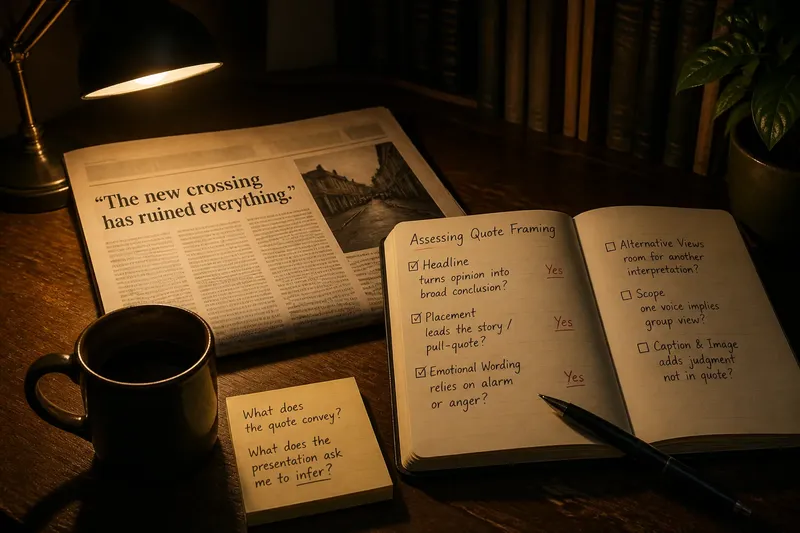
The most common mistake with a striking quotation is treating its vividness as proof of the claim attached to it. That shortcut gives a sentence more weight than it earns and costs readers the chance to notice what the words actually do: frame an issue, evoke a feeling, or direct attention toward one interpretation.
A quotation can make an argument feel immediate, but its rhetorical force is not the same as its evidentiary role. To read one carefully, ask how its wording guides the audience, what response it invites, and whether the surrounding presentation makes another interpretation harder to see.
How quotes frame claims
Framing is the selection and presentation of details that shape how an audience understands a subject. A quotation can frame an event as alarming, routine, unfair, or resolved without changing a single word. The choice of which sentence to feature, where to place it, and what headline surrounds it all affect the impression readers receive.
Consider the difference between opening a story with a speaker’s angry objection and opening with the calm explanation that prompted it. Both may be accurate excerpts, yet each gives the audience a different point of entry. The editorial decision is not merely which words to reproduce; it is which words are made prominent.
Notice the work a quote performs in its surroundings. Does it introduce a conflict, provide a human voice, signal urgency, or make a complicated issue easier to remember? Those functions can be legitimate. The question is whether the presentation also makes clear what kind of impression the quote is intended to create.
Emotion and emphasis
Strong emotional language attracts attention because it gives readers a ready-made response. A sentence that conveys anger or fear may help communicate a speaker’s perspective, but it can also steer an audience toward judging an entire issue through that moment. Emotional intensity is a feature of presentation, not a measure of how broadly the words apply.
Emphasis also comes from repetition, placement, and visual treatment. A quote in a large pull-quote box can feel central even if the surrounding text treats it as one person’s view. A headline that repeats the most provocative phrase may make that phrase seem like the story’s main finding.
Ask whether the quote’s emotional tone matches the point the article is making. If the sentence is used to suggest a general pattern, look for whether the article explains how far that inference reaches. A vivid individual voice can humanize a subject without standing in for every person affected by it.
What does the framing hide?
Every presentation selects some details and leaves others in the background. That is not automatically deceptive; readers need selection to make sense of information. But a quote can obscure alternatives when the framing gives one interpretation prominence and makes competing explanations difficult to notice.
Check the headline, caption, and surrounding paragraphs as well as the quoted sentence. Look for loaded labels, sharp contrasts, or a sequence that invites a conclusion before the supporting reasons appear. A quote that sounds like a final verdict may actually be a personal reaction, a prediction, or an argument in a larger dispute.
Imagine an invented local-news post that features a shopkeeper saying, “The new crossing has ruined everything.” The post places the quote beneath a headline blaming the crossing for a decline in business, while its text offers no other basis for that explanation. The sentence communicates the shopkeeper’s frustration; the framing encourages readers to treat that frustration as an account of cause. The distinction becomes visible when readers ask what the quote conveys and what the presentation asks them to infer.
How to assess quote framing
Use the following checks to identify how a quotation is shaping the message. Each one points to a decision: accept the framing as a fair presentation, qualify it, or look for a different account.
- Headline: Check whether the headline turns a speaker’s opinion into a broad conclusion; if it does, treat the conclusion as the publisher’s framing and look for reasons in the article, otherwise read the quote in the context provided.
- Placement: Check whether the quote leads the story or appears as a visual pull-quote; if its prominence exceeds the explanation offered, withhold judgment about its importance until you read the surrounding material, otherwise consider how it contributes to the argument.
- Emotional wording: Check whether the excerpt relies on alarm, ridicule, or anger; if emotion is doing most of the persuasive work, separate the reaction from the factual point, otherwise consider whether the tone helps explain the speaker’s perspective.
- Alternative views: Check whether the presentation makes room for another plausible interpretation; if it does not, seek context that could change the reading, otherwise compare how the competing views are described.
- Scope: Check whether one person’s voice is used to imply what a group thinks; if the article offers no basis for that wider implication, treat it as an unsupported framing choice, otherwise note how the wider claim is presented.
- Caption and image: Check whether a photo or caption adds a judgment not contained in the quote; if it does, distinguish that visual cue from the speaker’s words, otherwise assess the text and image together without treating them as interchangeable.
Questions about quote framing?
Can an accurate quote still create a slanted impression?
Yes. Selection, placement, and surrounding language can make a faithful excerpt seem to represent more than the speaker intended or the passage supports. Read the quote alongside its presentation rather than treating accuracy of wording as proof of fairness.
Does emotional language make a quote unreliable?
No. Emotion may be relevant to what a speaker is communicating, but it does not settle the broader point the article attaches to the words. Separate the speaker’s reaction from any conclusion the presentation asks you to draw.
How can I spot a loaded headline?
Compare the headline’s wording with the article’s own account of what the quote says. If the headline turns a personal view into a general verdict, treat that expansion as an editorial choice and look for support within the piece.
Should a quote always include another point of view?
Not every quotation needs an opposing voice beside it, especially when the passage is clearly presented as one person’s perspective. But if the article uses the quote to imply a wider conclusion, ask whether it gives readers enough context to understand other plausible readings.
When to move on
It is not worth trying to infer a writer’s private motives from one forceful sentence. That effort can distract from what is easier to examine: the headline, the quote’s placement, the surrounding explanation, and the range of interpretations the presentation allows.
When a quote sounds like proof, ask what impression its framing creates before deciding what it establishes. The phrase “quote framing” is useful here: it keeps attention on how selection and presentation guide interpretation, without confusing a compelling voice with a complete account.